—Audit Management Software
Audit management software, defined for a profession the IIA just rewrote.
A practitioner-written guide to what audit management software actually does, how it maps to the IIA 2024 Global Internal Audit Standards, and the questions to ask any vendor before you sign — from the team that built ControlVista for the GCC.
Aligned with the standards audit committees recognise.
- IIA Standards 2024
- COSO Internal Control
- ISO 19011
- GCC Public-Sector Overlay
—The Definition
What audit management software actually is.
The system of record for an internal audit function — and, in a profession the IIA just rewrote, an explicit instrument of conformance.
Audit management software runs the work the function is paid to do. It holds the risk universe and the annual plan, the engagement workpapers and the evidence behind them, the findings and the named actions, and the reports the audit committee actually reads.
What changed in 2025 is the bar. The IIA Global Internal Audit Standards 2024 — effective 9 January 2025 — replaced the 2017 IPPF with a single document of 5 Domains, 15 Principles and 52 Standards. Every Standard now ships with explicit Examples of Evidence of Conformance. The shared drive that worked yesterday no longer does.
A modern audit management system makes conformance fall out of normal work — preparer → reviewer → approver on every paper, the methodology behind every rating, the coordination with the second line, all logged as a by-product of doing the audit. Not assembled afterward for the External Quality Assessment.
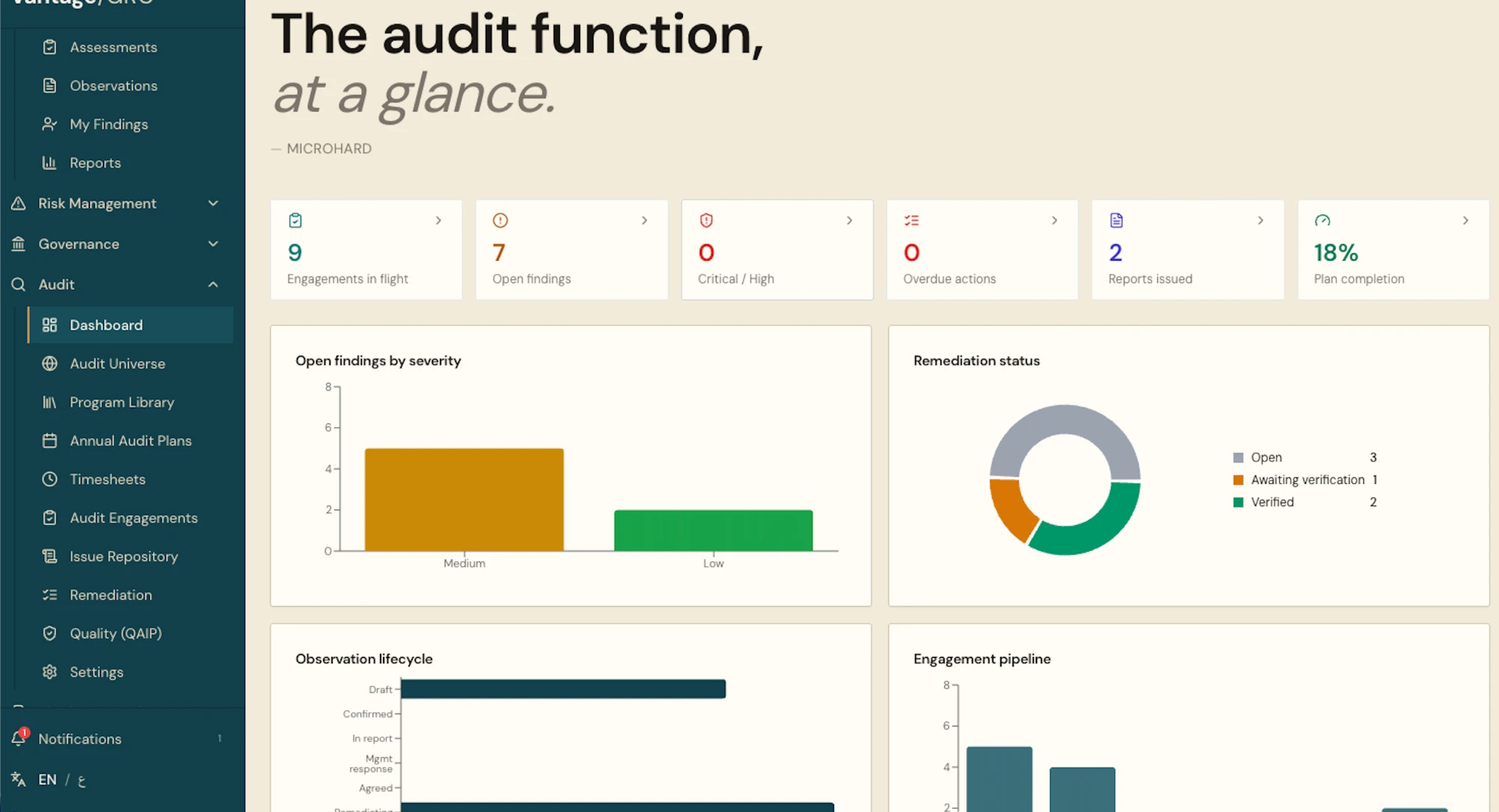
ControlVista — the live committee view, real-time plan progress, English / Arabic exports.
—The IIA 2024 Lifecycle
Audit management software has a shape now. This one.
The 2024 Standards run from Domain I (Purpose) through Domain V (Performing Internal Audit Services). The software follows the same arc.
Risk universe
A living catalogue of auditable entities — processes, systems, locations, third parties — scored on the risk dimensions the audit committee actually cares about.
Annual plan
Coverage built from the universe, not from a wish-list. Capacity, dependencies, and committee priorities reconciled in one view.
Engagement & workpapers
Fieldwork captured where it happens — tests, evidence, sampling, interviews — with three-stage sign-off (preparer / reviewer / approver) on every paper.
Findings & remediation
Structured findings (condition, criteria, cause, effect, recommendation), agreed actions with named owners, and auditee self-service for status updates.
Reporting & the committee
Engagement reports, the annual opinion, and the board-ready committee pack — assembled from the live record, not retyped from a tracker.
AI across the lifecycle
Drafting assistants that suggest procedures, summarise evidence, narrate findings, and assemble committee packs — always inside your perimeter, never deciding.
Beyond the core Standards, The IIA publishes Topical Requirements — the first, on Cybersecurity, becomes mandatory on 5 February 2026, with Third-Party, Culture, and Business Resilience following. Buy software that can absorb a new Topical Requirement without re-platforming.
—The Buyer's Checklist
Ten questions to ask any audit management software vendor.
Written by practitioners. Each question is the one a vendor would prefer you didn't ask first.
- 01
Is the IIA 2024 lifecycle the spine, or a tag in a generic GRC tool?
The 2024 Global Internal Audit Standards reorganised the profession into 5 Domains, 15 Principles and 52 Standards. The platform should reflect that — universe, plan, engagement, opinion, action — not a ticket system bent into an audit shape.
- 02
Does evidence of conformance fall out of normal work?
Every 2024 Standard now ships with explicit Examples of Evidence of Conformance. Look for software that captures the artifact and the decision at the moment they happen, so quality assessment doesn't become a separate documentation exercise.
- 03
Is three-stage sign-off built into the workflow?
Preparer → reviewer → approver should be a property of every working paper, every finding, every report — produced as a by-product of doing the work, not assembled afterward for the EQA.
- 04
Can it run on-premise if you need it to?
Most modern audit platforms are SaaS-only. For regulated banks, public-sector entities, and infrastructure operators in the GCC, on-premise or sovereign-cloud deployment is often non-negotiable. Confirm before, not after.
- 05
Does it render natively in Arabic, or just translate?
A truly bilingual platform stores Arabic at the field level, mirrors RTL layouts, and produces Arabic committee packs without manual rework. Translation layers leak through to the boardroom.
- 06
Is the AI inside the workflow or beside it?
A chatbot bolted on top isn't audit AI. Look for assistants embedded where the keyboard work happens — procedure suggestion in planning, evidence summarisation in fieldwork, finding narration in remediation, report drafting in reporting.
- 07
Does it produce the audit opinion, or just the data behind it?
Standard 14.3 of the 2024 Standards requires CAEs to document the methodology behind ratings and prioritisation. The software should make that methodology explicit — and never substitute its own.
- 08
Will it coordinate with the other lines of assurance?
Coordination with other assurance providers moved from “should” to “must” in Standard 9.5 of the 2024 Standards. The platform should expose a combined-assurance view, not silo internal audit.
- 09
Can the audit committee see the truth in real time?
Plan progress, outstanding high-risk findings, action ageing — exportable in English and Arabic. The committee should not need a separate Excel pack stitched together the day before the meeting.
- 10
Who owns your data, and where does it live?
Get explicit answers: where evidence is stored, who can access it, what happens at contract end, whether source-code escrow is available for procurement sign-off.
—The Profession in Numbers
Where internal audit actually stands in 2026.
The honest picture from independent and primary sources — the brief you'd give the audit committee before they ask why the function needs new software.
25%
AuditBoard 2025 Risk Intelligence Report (213 IA leaders)
28%
AuditBoard 2025 Risk Intelligence Report
47%
IIA 2025 North American Pulse of Internal Audit
86%
IIA 2025 North American Pulse of Internal Audit
62%
Deloitte 2026 Southeast Asia CFO Program / Audit Committee report
$51.4bn
Mordor Intelligence GRC Platforms Market 2025
Sources: AuditBoard 2025 Risk Intelligence Report (vendor-published, surveyed 213 IA leaders); The IIA / AuditBoard 2025 North American Pulse of Internal Audit; Deloitte Southeast Asia CFO Program — Audit Committees and CFOs Report; Mordor Intelligence — GRC Platforms Market 2025. Statistics independently verified before publication.
—Why ControlVista
The audit management system the GCC has been waiting for.
Built by practitioners in Doha. Bilingual at the schema level. On-premise by default. The IIA 2024 lifecycle as the spine, not a tag.
On-premise by default
Runs inside your perimeter — data centre or private cloud. The vendor never sees an engagement file. Source-code escrow available for procurement sign-off.
Bilingual at the schema level
English and Arabic on every user-facing field. Reports and committee packs render natively in both languages — built for the GCC from the schema up.
Auditable by design
Every action belongs to a named person. Preparer → reviewer → approver, immutable history, evidence-of-conformance ready for the next EQA.
AI that drafts, not decides
VistaAssist accelerates the writing across every module, then hands the judgement back to the auditor. Drafts are editable, attributed, and always inside the perimeter.
—Frequently Asked
Audit management software, plainly answered.
What is audit management software?
Audit management software is the system of record for an internal audit function. It maintains the risk universe and annual plan, runs the workpapers and evidence for each engagement, captures findings with named action owners, tracks remediation through to closure, and produces the engagement reports and the audit-committee pack from the live record. Modern audit management systems are aligned to the IIA Global Internal Audit Standards 2024 and replace the patchwork of spreadsheets, shared drives and ticket trackers that most functions still rely on.
Is audit management software the same as GRC software?
No. GRC platforms are organisation-wide — they hold the risk register, the control library, policy management, regulatory obligations and (often) IT risk. Audit management software is the specialist tool the internal audit function uses to do its work against that universe: planning, fieldwork, findings, remediation and committee reporting. A good audit platform integrates with the GRC layer but speaks the auditor's language, follows the IIA lifecycle, and produces the evidence of conformance the 2024 Standards require.
How does audit management software map to the IIA 2024 Standards?
The 2024 Global Internal Audit Standards became effective 9 January 2025 and reorganised the profession into 5 Domains, 15 Principles and 52 Standards. The lifecycle the software must support — universe, strategy (9.2), plan, engagement, methodology for ratings (14.3), coordination with other assurance providers (9.5), and reporting — is the spine of the new Standards. Crucially, each Standard now ships with explicit Examples of Evidence of Conformance, which the software should produce as a by-product of normal work, not as a separate documentation exercise.
Do I need a SaaS platform, or can audit management software run on-premise?
Both deployments exist, but the dominant model among global vendors is SaaS-only. For GCC banks, public-sector bodies and infrastructure operators — where regulators require data to remain in-country or inside the perimeter — on-premise or sovereign-cloud deployment is often non-negotiable. ControlVista runs on-premise by default, with source-code escrow available for procurement sign-off; we don't have access to your engagement files at any time.
What about AI? Is audit management software safe to use with sensitive evidence?
It depends entirely on where the AI runs. A chatbot built on a public model that ingests your workpapers is a confidentiality and conformance problem. ControlVista's approach (VistaAssist) is to run drafting assistants inside your perimeter, attribute every draft to a named auditor, and never let the AI sign, approve or close anything on its own — the standard's preparer → reviewer → approver chain stays unbroken.
Does audit management software need to support Arabic for GCC teams?
If you report to a Gulf audit committee, yes. Translation layers leak through to the boardroom. ControlVista stores Arabic at the field level — not as a translation overlay — and produces native Arabic committee packs and findings in RTL layout, alongside English. The product screenshots in our customers' demos are real bilingual screenshots, not mocked translations.
How long does it take to implement audit management software?
A typical mid-sized internal audit function (8–25 auditors) moves from contract to first live engagement in 6–12 weeks, assuming the audit universe and methodology are reasonably documented. The bottleneck is almost never the software; it's reconciling the function's existing universe, ratings methodology and committee reporting templates so they import cleanly. Vendors who promise 2-week go-lives are usually skipping that reconciliation.
How is audit management software priced?
Most enterprise audit platforms are priced per named user, with module-level upcharges (e.g. AI, third-party risk, IT audit). List prices are rarely public; expect mid-five-figure annual contracts for small functions and six-to-low-seven figures for large enterprises. ControlVista publishes its pricing model openly during procurement and offers fixed per-deployment pricing for on-premise customers — talk to us about a quote that reflects your function's size, not a SKU sheet.
—Keep Reading
Best audit management software — 2026 comparison
How AuditBoard, Workiva, Diligent, MetricStream, TeamMate, Ideagen Pentana, Resolver, Onspring, ServiceNow GRC, SAP and ControlVista compare.
Audit management software in Qatar
QFMA governance, QCB rulebook, Qatar Audit Bureau — and the bilingual, on-premise platform that fits.
Audit management software in Saudi Arabia
SAMA, CMA, GCA, and an audit management system aligned with Vision 2030's governance push.
Audit management software in the UAE
CBUAE, SCA, UAE Accountability Authority — and a platform that respects on-premise procurement.
VistaAssist — audit AI that drafts, not decides
Procedure suggestion, evidence summarisation, finding narration, report drafting — all inside your perimeter.
Field notes from the function
Practitioner essays on the IIA 2024 transition, AI in audit, the audit committee, and the GCC market.
—Request a demo
See ControlVista run your audit lifecycle, end to end.
A 30-minute walkthrough with the team that built it — from the audit universe to the board-ready committee pack, in English and Arabic.
A product of Vantage Technologies.